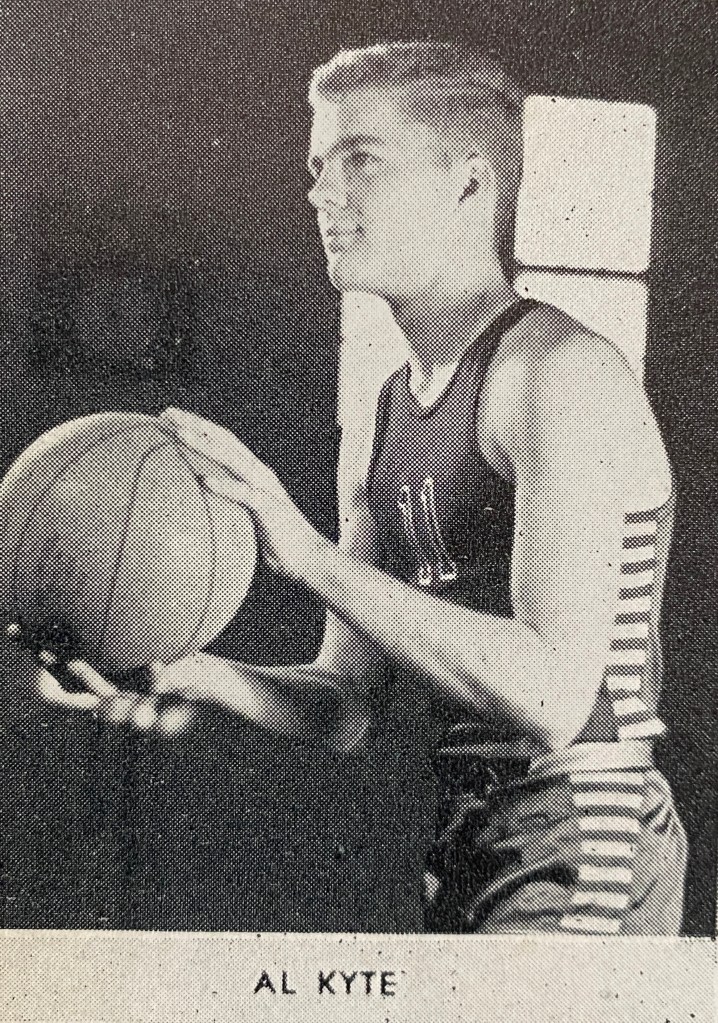
Al Kyte
When first considering coaching as a career, I read what some of the most highly regarded coaches had to say about their experiences. What stuck with me was that so many of them placed an emphasis on teaching values. My dad taught his teams to play to win and they did win 22 championships, but he also maintained that the values you taught were even more important. I got a painful reminder of that after he saw my first basketball team play. That team had already won a game against a bigger, more talented team, and I was beginning to believe the favorable press clippings about my coaching. On the day my dad watched, we were pulling another upset when my players made a few critical errors and let the game slip away. In a huddle during the last minute I was urging them on but also chewing them out.
Later that night my dad said, “It’s none of my business…” I immediately sensed this wasn’t going to be good. He continued, “…but you were hard on those boys. They played over their heads, and when they made a few mistakes, you jumped all over them. Those are young boys many of whom will be playing for you next year. You might ask yourself why you went into coaching. When I went in to coaching, it wasn’t as much about making better basketball or baseball players as about helping those boys become better people.” At that moment I realized I was becoming the type of coach I despised, and I hadn’t even seen it coming.
He told me that when this country was changing from being mostly rural to more urban, educators wondered how our youth would still be able to learn the important values of rural life. Their answer was to include sports in school life as a way of teaching such values. But what values?

Of the many values of rural life, I believe the most obvious is hard work, starting early in the day. Most coaches do encourage a “work ethic” by praising those players who are the first in the gym and the last to leave. Just as it takes work over time to prepare for a harvest, it takes practice over time to develop sport skills. And teacher/coaches also encourage their players to work hard in their classes as well. Hard work on a farm also means everyone there is held responsible for doing their assigned chores. Such teamwork, when taught in sports, enables a group that plays as a team to sometimes defeat a more talented group that doesn’t.
Doing farm chores often leads to the habit of trying to fix things yourself. This becomes important in the back country when there is no one else to help. Such self-reliance also cultivates an admirable outlook in athletes that asks “How can I help?” instead of “What can you give me?” This may be the most difficult rural value for coaches to teach and among the most neglected.
Other related teachings of rural life such as helping needy people in the community, honoring spoken commitments, respecting the law and dealing with difficult seasons can be taught as sportsmanship by coaches who emphasize respecting officials, opponents, and rules of the game, helping teammates, winning humbly, and losing gracefully.
As I look at the values of city life today including the impact of our computerized life, I believe there is now more of a need than ever before to teach values that help build strong character. It seems that each generation needs to be taught that the character we bring is at least as important as what we do. Today’s coaches may know somewhat more about teaching sport skills than in past years, but in the bigger picture of life I believe those old coaches had it right.