
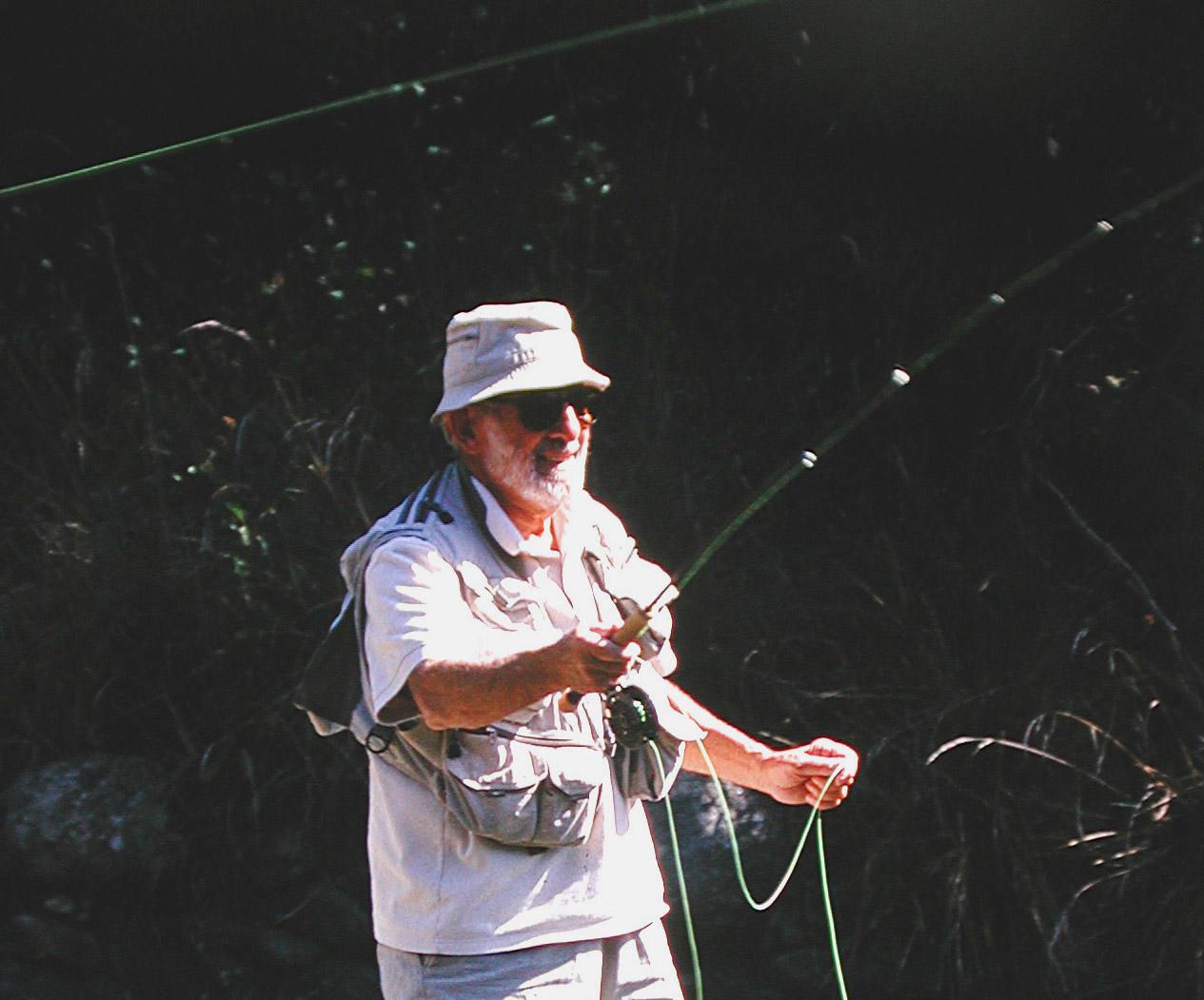
I caught my first fish on a fly in the 1940s and within a few decades was teaching, speaking, guiding, writing and consulting on fly fishing. What I did that most influenced fly casting instruction here and abroad was my bio-mechanics research—both on distance and styles of fly casting. That work opened the door to exchanging ideas with many of the world’s premier fly-casting instructors. One I was close to was Mel Krieger who often picked my brains about teaching as I was picking his about casting. I think that interaction helped both of us approach our potential as leaders in the sport. Mel loved being in front of people teaching them fly casting, and they loved his passion as well. We often taught fly fishing schools together, but the time I would most like to have been with him, I wasn’t. So for this story I have to rely on others.
On that day, Mel was the featured casting instructor at a fly fishing school in the Rocky Mountains. As he was explaining a cast to the students on the lawn there, Mel was holding his fly rod with the line dropping to the grass slightly behind him. At the end of his fly line was a length of thin monofilament line we call a leader with a small piece of yarn knotted to its end to represent the fly. Thus students could practice casting without any worry of hooking themselves.
Two of the the other teachers waiting to give hands-on casting help to the students were entomologist, Dave Donahue, and casting expert, Tim Rajeff, both fun-loving men. They had taught frequently with Mel and knew what he was going to say next and how long it would take. At one moment during Mel’s explanation, Dave reached down to the grass to capture a resting bumble bee by its wings. Out of view behind Mel, Dave got Tim’s attention and whispered something to him. Tim smiled and then walked up close enough to Mel to pick up his leader when Mel was looking the other way. Tim was able to take that leader back farther out of Mel’s view without him being aware of it, snip off the yarn fly from the end of the leader, and quickly tie a slip-knot loop in it. Then together Tim and Dave worked to slide that loop over the head of the bumble bee and tighten it up. Dave then walked back toward Mel and at the right moment placed the leader and its attached bee on the grass close to where the yarn fly had been. Fortunately the bee was content to continue sitting on the grass as Mel concluded his remarks.
Then the moment came for Mel to demonstrate the cast he had been describing. With characteristic grace and skill, he deftly moved the rod to lift the line into the air as he had done so often to start his backward and forward casting movements. But this time something was different. His yarn fly had come to life and was initiating its own flight patterns at the end of his line. I knew Mel’s expressions well and could imagine his look. He had to be saying to himself, “What in the world is happening here?”
Mel’s students had seen what was going on behind his back, but no one tipped him off. I believe it is just too much to expect of people to interrupt something that might prove so entertaining. What Mel thought about all this, I never heard. Had it happened to me, I like to think I would have been able to join in on the laughter, but honestly, I’m not sure how I would have reacted. As recognized experts, we would just as soon have these moments happen to someone else. But, oh, how I would love to have seen that.
 Al Kyte's Life Take-Aways
Dad, I don’t think I’ve ever heard this story!! This is hilarious!!! Mike said he’s heard it though and that I need to go to Butte Meadows more! Ha! Loved it!! Another great blog by my amazing Dad!!
LikeLike
What a funny story. Knowing you I’m sure you would have laughed as much as the others.
How lucky they are to have a friend like you.
LikeLike